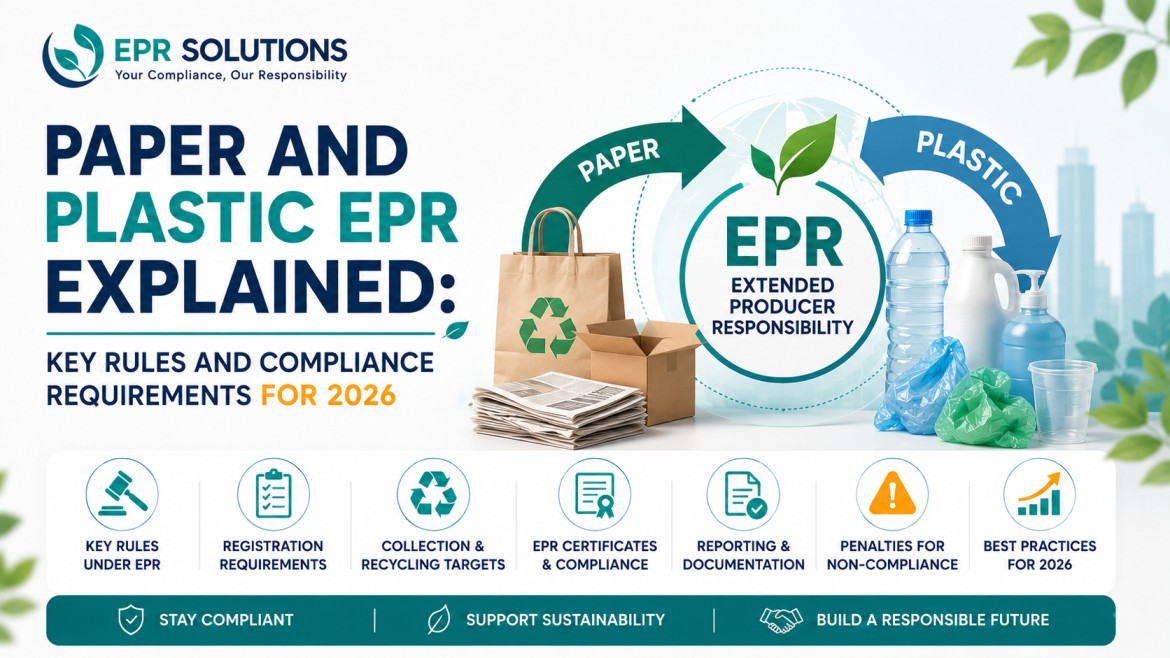
India's EPR landscape for packaging has shifted dramatically in 2026. Two major regulatory developments — the Plastic Waste Management (Amendment) Rules, 2026 and the new Environment Protection (EPR for Packaging) Rules for paper, glass, and metal — have reshaped what producers, importers, and brand owners are legally required to do. If your business uses plastic or paper packaging, this guide explains what has changed, what your obligations are, and what steps you need to take to remain compliant.
This is not a theoretical overview. It covers the specific rules, targets, deadlines, and practical requirements that apply to your business in FY 2025-26 and FY 2026-27.
What is EPR for packaging, and why does it matter in 2026?
Extended Producer Responsibility (EPR) is a regulatory framework that transfers the financial and operational responsibility for end-of-life waste management from municipalities to the businesses that introduce products into the market. Under EPR, a producer, importer, or brand owner (collectively referred to as a PIBO) is accountable for ensuring that the packaging they use — plastic, paper, glass, metal — is collected, recycled, or responsibly disposed of after the consumer is done with it.
India's EPR system for plastic packaging has been operational since the Plastic Waste Management (Amendment) Rules, 2022 introduced mandatory collection targets and the centralized CPCB portal. What has changed in 2026 is the scope, the stringency, and the tools of enforcement:
- Plastic EPR now includes mandatory recycled content targets in addition to collection obligations — not just collecting waste, but actively using recycled material in new packaging.
- Paper and paperboard packaging has come under EPR for the first time, with the new rules effective from April 1, 2026.
- A formalized tradable certificate system now operates alongside the obligation framework, enabling market-based compliance flexibility.
- QR code traceability is mandatory on all plastic packaging, enabling regulators to link packaging back to registered PIBOs.
- Independent environmental auditors have been introduced to verify EPR claims from the FY 2026-27 cycle onwards.
Key point: If your business uses plastic or paper packaging and you have not yet registered on the CPCB EPR portal, you are already non-compliant. Registration is the prerequisite for everything else — certificate trading, annual return filing, and demonstrating legal compliance.
Plastic EPR in 2026: what the PWM Amendment Rules changed
The Plastic Waste Management (Amendment) Rules, 2026 — notified via G.S.R. 237(E) on 31 March 2026 — build on the EPR framework established in 2022 and introduce several structural changes that every PIBO using plastic packaging needs to understand.
1. Mandatory recycled content in plastic packaging
The most significant shift in the 2026 amendment is the move from a collection-focused obligation to a circular content obligation. PIBOs must now ensure that a defined percentage of the plastic in their packaging consists of recycled material — not just that an equivalent weight of plastic waste was collected somewhere in the economy. The targets are category-specific and escalate annually:
Category I — Rigid Plastics
FY 2025-26: 30% recycled content
FY 2026-27: 40% recycled content
FY 2027-28: 50% recycled content
FY 2028-29 onwards: 60% recycled content
Examples: bottles, containers, caps, rigid trays
Category II — Flexible Plastics
FY 2025-26: 10% recycled content
FY 2026-27: 10% recycled content
FY 2027-28 onwards: 20% recycled content
Examples: films, pouches, flexible wrappers, carry bags ≥120 microns
Category III — Multi-Layered Plastics
FY 2025-26: 5% recycled content
FY 2026-27: 5% recycled content
FY 2027-28 onwards: 10% recycled content
Examples: snack wrappers, tetra-like laminated packaging, biscuit pouches
Category IV — Compostable Plastics
Certified compostable packaging must meet IS 17088 certification standards. EPR obligations for this category focus on ensuring proper composting infrastructure and end-of-life documentation rather than recycled content.
Examples: certified compostable carry bags, food-service packaging
An important exemption applies: where FSSAI regulations or other statutory requirements prohibit the use of recycled plastic in food-contact packaging, PIBOs may apply for case-specific exemptions from CPCB. Producers unable to meet recycled content requirements in these cases can purchase equivalent EPR certificates from waste processors who have exceeded their targets.
2. Reuse obligations for rigid plastic packaging
Beyond recycled content, the 2026 rules introduce reuse targets for rigid plastic packaging (Category I). Brand owners are required to ensure that a defined proportion of rigid containers are designed and actually used for multiple fill cycles rather than single use:
- Rigid packaging with a capacity of 0.9–4.9 litres: minimum 10% reuse target in FY 2025-26, increasing to 25% by FY 2028-29.
- Drinking water packaging of ≥4.9 litres: 70% reuse target from FY 2025-26, increasing to 85% by FY 2028-29.
- Other large-format packaging ≥4.9 litres: 10% reuse target in FY 2025-26, rising to 15% by FY 2028-29.
3. The three-year carry-forward provision
Recognising that many PIBOs were unable to fully meet their EPR targets for FY 2025-26 — partly due to supply chain constraints on recycled content and partly due to regulatory transition — the 2026 amendment introduces a structured carry-forward mechanism. PIBOs that fall short of their FY 2025-26 obligations will not face immediate full penalties, provided they meet the following conditions:
- The unmet obligation can be carried forward for up to three financial years: 2026-27, 2027-28, and 2028-29.
- At least one-third of the original shortfall must be cleared each year.
- Paying Environmental Compensation does not discharge the recycling obligation — the physical targets must still be achieved through certified waste processors or EPR certificate purchases.
The carry-forward provision applies specifically to food-contact packaging shortfalls where FSSAI constraints were a demonstrable barrier. Businesses should document the reasons for any FY 2025-26 shortfall carefully, as CPCB audits are expected to scrutinize carry-forward claims from FY 2026-27 onwards.
4. Formalized tradable EPR certificate system
The 2026 amendment formally codifies the tradable certificate system that has been operating informally for plastic EPR. PIBOs who exceed their recycled content or collection obligations generate surplus EPR certificates. Those unable to fully meet their own targets can purchase these certificates from surplus holders — plastic waste processors (PWPs) who have generated and verified credits through the CPCB EPR portal. All transactions are recorded on the portal and are fully auditable. This market-based mechanism provides compliance flexibility while maintaining regulatory accountability.
5. Mandatory QR code and barcode labelling
From July 1, 2025 (under CPCB's January 2025 amendment to Rule 11 of the PWM Rules), all plastic packaging sold in India must display the PIBO's name, their CPCB EPR registration number, and other required information on-pack via a QR code, barcode, or unique identifier number. This enables end-to-end traceability — regulators can scan packaging to identify the registered entity responsible for its end-of-life management. Non-compliant packaging may be treated as unregistered and subject to regulatory action.
6. Independent environmental auditors
From FY 2026-27 onwards, CPCB has introduced Registered Environmental Auditors (REAs) who verify EPR claims made by brand owners. This decentralized verification mechanism reduces pressure on the CPCB portal alone and introduces an independent check on declared recycled content usage and collection volumes. Businesses should prepare for third-party audits of their EPR compliance documentation going forward.
Who must register for plastic EPR?
Registration on the CPCB EPR portal (eprplastic.cpcb.gov.in) is mandatory for any entity in the following categories that introduces plastic packaging into the Indian market:
- Producers: Businesses that manufacture packaged goods — food, beverages, personal care, pharmaceuticals, FMCG, industrials — using plastic packaging, as well as manufacturers of plastic packaging materials themselves.
- Importers: Businesses that import plastic-packaged goods, or import plastic raw materials (resins, pellets, and intermediate materials — a category expanded by the 2024 amendment).
- Brand Owners: Companies that sell products under their own label using plastic packaging, even if manufacturing is outsourced to a contract manufacturer.
- E-commerce Platforms and Sellers: Online sellers using plastic packaging for fulfilment and delivery.
- Plastic Waste Processors (PWPs): Recyclers and waste-to-energy operators who wish to generate EPR certificates must also register as PWPs on the portal.
The size of a business does not exempt it from registration. Small and medium businesses using plastic packaging must comply in the same way as large corporations — the obligation scales proportionally with declared volumes, but the registration requirement is universal.
Paper EPR in 2026: the new framework
Until 2026, paper and paperboard packaging was governed under the Solid Waste Management Rules and carried no specific EPR obligations. That changed on April 1, 2026, when the Environment Protection (Extended Producer Responsibility for Packaging made from Paper, Glass, Metal and Sanitary Products) Rules, 2024 came into force.
This framework is structurally similar to plastic EPR — it creates registration obligations, annual recycling targets, recycled content requirements, EPR certificate mechanisms, and Environmental Compensation provisions — but is implemented through a new centralized portal being developed by CPCB specifically for this category.
Who is covered under paper EPR?
The rules apply to three categories of entities that use paper or paperboard packaging:
- Producers: Entities that manufacture goods using paper or paperboard packaging and introduce them into the Indian market — including carton manufacturers, corrugated box producers, and FMCG companies packaging in paper.
- Importers: Businesses that import products in paper or paperboard packaging.
- Brand Owners: Companies whose branding appears on paper-packaged products, regardless of who manufactures the packaging or the product.
Plastic packaging is explicitly excluded from these new rules — it continues to be governed under the Plastic Waste Management Rules, 2016 as amended. The paper EPR rules also cover glass and metal packaging (separate from plastic) and sanitary products such as diapers and sanitary napkins, under the same regulatory instrument.
Paper EPR recycling targets
PIBOs under the paper EPR framework must meet minimum annual recycling targets calculated on the basis of their declared packaging volumes. The framework sets a collection and recycling obligation starting at 70% of the PIBO's annual packaging footprint from FY 2026-27, increasing progressively to 100% by FY 2028-29.
To meet these targets, PIBOs must obtain EPR certificates from CPCB-registered paper waste processors — recyclers, material recovery facilities, and composters authorized to handle paper and paperboard — and submit them through the annual return process.
Recycled content requirements for paper packaging
In addition to collection targets, PIBOs must progressively increase the proportion of recycled paper content in their packaging materials:
- FY 2026-27: Minimum 40% recycled content in paper and paperboard packaging
- This target rises to 70% by FY 2029-30, requiring a significant shift in procurement practices for large paper packaging users.
Annual return filing for paper EPR
PIBOs must submit annual returns by June 30 of the subsequent financial year, declaring the quantity of paper packaging introduced into the market and the EPR certificates obtained to cover their recycling obligations. CPCB cross-checks these submissions against the records of registered paper waste processors. In cases of discrepancy between reported figures, the lower number is used for compliance calculation.
How EPR obligations are calculated for paper and plastic
Both the plastic and paper EPR frameworks use a similar method to calculate a PIBO's annual compliance obligation. Understanding this calculation prevents both over-procurement of certificates and under-reporting of volumes.
Declare your annual packaging volumes
Log into the relevant CPCB EPR portal and declare the quantity (in metric tonnes or kilograms) of plastic or paper packaging introduced into the Indian market in the relevant financial year. For importers, this is based on customs import records and GST-linked invoices. For domestic producers and brand owners, it is based on sales data and procurement records.
Calculate your base EPR target
For most categories, the EPR target is calculated as the average of packaging volumes introduced in the last two financial years, multiplied by the applicable target percentage for the current year. For example, a producer who introduced 10 MT of plastic packaging in FY 2023-24 and 14 MT in FY 2024-25 has an average base of 12 MT, against which the applicable recycling target percentage is applied.
Determine how much you have already fulfilled internally
If your business has its own collection infrastructure or operates a take-back scheme with a registered recycler, the verified quantities processed through that arrangement can be credited against your obligation. This requires documented processing records and, in most cases, GST-linked invoices from the recycler.
Purchase EPR certificates for the remaining shortfall
The difference between your total obligation and your internally fulfilled quantity must be covered by purchasing EPR certificates from CPCB-registered waste processors. Certificates must match the specific category of your obligation — a Category I plastic certificate cannot offset a Category II obligation.
File your annual return by June 30
Submit your annual return on the CPCB portal by June 30, reconciling declared volumes against certificates held. Retain all supporting documentation — portal transfer receipts, GST-linked invoices from recyclers, weighbridge slips, and audit reports — as these may be subject to CPCB or third-party verification.
Key compliance deadlines for 2026
Staying ahead of compliance deadlines reduces both penalty risk and last-minute certificate procurement costs, which typically spike near filing periods. The most important dates for paper and plastic EPR compliance in 2026 are:
The Environment Protection (EPR for Packaging) Rules for paper, glass, and metal became effective on this date. PIBOs using paper or paperboard packaging are now legally obligated to register and begin tracking their packaging volumes for the FY 2026-27 cycle.
The first year of mandatory recycled content obligations under the PWM Amendment Rules 2026 is FY 2025-26. Category I (rigid) plastics must contain a minimum of 30% recycled content. Category II (flexible) and Category III (multi-layered) require 10% and 5% respectively.
PIBOs must file their FY 2025-26 annual EPR returns on the CPCB plastic EPR portal by June 30, 2026, declaring packaging volumes and EPR certificates acquired. Note: CPCB extended the FY 2024-25 deadline to January 31, 2026. The FY 2025-26 deadline should be treated as June 30, 2026 unless CPCB issues a further extension.
Registered Environmental Auditors (REAs) will begin verifying EPR compliance claims from FY 2026-27. Businesses should ensure their documentation — recycled content purchase invoices, material specifications, laboratory test reports — is audit-ready before submitting annual returns.
From FY 2026-27, paper packaging PIBOs must meet the 40% recycled content requirement and the 70% collection/recycling target. Registration and procurement planning for paper EPR certificates should begin immediately.
Penalties for non-compliance: what businesses face
India's EPR enforcement has become significantly more active since 2024. CPCB and State Pollution Control Boards have moved beyond advisory notices to actual penalty actions — and the financial consequences are material.
Under Section 15 of the Environment Protection Act, 1986, penalties for EPR non-compliance include:
- Environmental Compensation (EC): Calculated under the polluter-pays principle on the basis of the unmet EPR obligation. Paying EC does not discharge the underlying recycling obligation — the shortfall must still be physically addressed.
- Monetary fines: ₹10,000 to ₹15 lakh per violation, with ₹10,000 per day for continuing violations.
- Registration suspension or cancellation: CPCB has authority to suspend or cancel EPR registration, which effectively prevents a business from legally marketing plastic-packaged products in India. This is the most operationally disruptive penalty.
- Legal prosecution: Willful non-compliance can attract criminal prosecution — up to five years' imprisonment and fines of up to ₹1 lakh per day of violation.
Real-world enforcement examples illustrate that these are not theoretical penalties. A Delhi-based importer and BPCL have both faced significant Environmental Compensation actions for EPR lapses in 2025. CPCB has stated its intention to escalate enforcement as the 2026 framework takes full effect.
EPR certificates for paper and plastic: how they work
Whether you are dealing with plastic or paper packaging, EPR certificates are the instrument through which you demonstrate compliance. Understanding how they are generated, traded, and submitted is essential for any PIBO operating in 2026.
For plastic EPR, certificates are issued by CPCB-registered Plastic Waste Processors (PWPs) — recyclers, co-processors, waste-to-energy operators — who generate credits after uploading verified processing records to the CPCB plastic EPR portal. Certificates are category-specific (Category I, II, III, or IV) and expressed in metric tonnes.
For paper EPR, a parallel system is being established. CPCB-registered paper waste processors — material recovery facilities, pulp and paper recyclers, composters — will generate EPR certificates against verified processing of paper and paperboard packaging. PIBOs must obtain these certificates and submit them alongside their annual returns.
In both frameworks, surplus certificates — generated when processors or PIBOs exceed their targets — can be carried forward or traded. For plastic EPR, the EPRETP (Extended Producer Responsibility Electronic Trading and Settlement Platform), operated by MSTC Limited under CPCB oversight, provides a regulated marketplace for certificate trading. A similar trading mechanism is expected to be developed for paper EPR as the framework matures.
To learn more about how EPR certificates work in detail — including issuance, trading mechanics, and the EPRETP platform — see our full guide: EPR Certificates Explained: What They Are, Who Issues Them, and How to Trade Them.
Common compliance mistakes to avoid in 2026
Registration is the start, not the finish. Annual return filing, packaging volume declarations, recycled content compliance, and certificate procurement are all ongoing obligations. A dormant registration without annual filings will attract regulatory scrutiny.
The paper EPR rules are now in force. Businesses that use corrugated boxes, paper cartons, paperboard trays, or other paper-based packaging and have not begun registration planning are already behind. The first annual return for paper EPR covers FY 2026-27 packaging volumes, due June 30, 2027 — but registration and baseline data collection should start now.
Pre-2026, plastic EPR focused primarily on ensuring an equivalent weight of plastic waste was collected and processed. From 2026, the obligation requires that the plastic in your actual packaging contains a specified percentage of recycled material. These are different compliance activities requiring different documentation and supplier relationships.
CPCB has flagged significant volumes of fraudulent and inflated certificates — over 600,000 fake plastic certificates were identified in one prior review period. Always verify that a recycler's CPCB registration is active and current before accepting any certificate transfer. Invalid certificates do not satisfy your compliance obligation.
Certificate prices spike near annual return filing deadlines as demand concentrates. Businesses that plan procurement across the full financial year benefit from better pricing, greater availability, and time to resolve any documentation issues before the filing deadline.
From July 1, 2025, plastic packaging without a QR code, barcode, or unique identifier carrying the PIBO's name and CPCB EPR registration number is non-compliant under Rule 11 of the PWM Rules. This is a product-level obligation, not just a reporting one — it affects every SKU your business sells in plastic packaging.
Practical steps to achieve compliance in 2026
For businesses assessing their current compliance position, the following framework covers both plastic and paper EPR obligations:
Audit your packaging footprint
Map every packaging material your business introduces into the Indian market — plastic (by category), paper, glass, metal. Calculate the annual volumes by financial year. This inventory forms the basis of your EPR obligation calculation and your annual return declaration.
Register on the relevant CPCB EPR portals
If you use plastic packaging, register on the CPCB plastic EPR portal (eprplastic.cpcb.gov.in) as a PIBO. Once the paper EPR portal is operational, register there as well. Gather the required documents: GST certificate, PAN, company incorporation certificate, and authorized signatory details.
Assess your recycled content compliance
For plastic packaging, work with your packaging suppliers to verify that the materials you are procuring meet the applicable recycled content percentage for your categories. Request material specification sheets and test reports. For packaging where FSSAI restricts recycled content use, begin preparing the documentation required to claim an exemption from CPCB.
Identify and verify EPR certificate suppliers
Build relationships with CPCB-registered waste processors in your relevant packaging categories. Verify their registration status on the portal before committing to any transaction. Establish a procurement schedule that spreads certificate purchases across the financial year to manage cost and availability risk.
Update packaging labels for QR code compliance
Ensure all plastic packaging in production and inventory carries a compliant QR code or barcode linking to your CPCB registration details. Coordinate with your packaging designers, printers, and supply chain to roll out compliant packaging across all SKUs.
Prepare documentation for audit readiness
From FY 2026-27, Registered Environmental Auditors will verify EPR claims. Maintain a compliance file for each financial year containing: portal registration certificates, annual return filings, EPR certificate transfer receipts, GST-linked invoices from recyclers, recycled content test reports, and any CPCB correspondence. This documentation must be available on request.
Need help navigating paper or plastic EPR compliance?
Our team assists producers, importers, and brand owners with EPR registration, obligation calculation, certificate procurement, and annual return filing — across plastic, paper, e-waste, battery, and tyre categories.
Talk to an expertFrequently Asked Questions
The Plastic Waste Management (Amendment) Rules, 2026 (G.S.R. 237(E), notified 31 March 2026) introduce mandatory recycled content targets for all plastic packaging categories, reuse obligations for rigid plastic containers, a formalized tradable EPR certificate system, a three-year carry-forward provision for FY 2025-26 shortfalls, and mandatory QR code or barcode labelling on all plastic packaging. These build on the collection-focused EPR framework established in 2022 by adding a circular content dimension.
Yes. The Environment Protection (Extended Producer Responsibility for Packaging made from Paper, Glass, Metal and Sanitary Products) Rules, 2024 came into effect on April 1, 2026. These rules impose EPR obligations on producers, importers, and brand owners that use paper and paperboard packaging, covering registration, annual return filing, recycling targets (70% by FY 2026-27, rising to 100% by FY 2028-29), and recycled content requirements (40% by FY 2026-27, rising to 70% by FY 2029-30).
Any Producer, Importer, or Brand Owner (PIBO) that introduces plastic or paper packaging into the Indian market must register on the relevant CPCB EPR portal. This includes manufacturers of packaged goods, importers of plastic or paper-packed products, e-commerce sellers, and brand owners who outsource manufacturing but sell under their own label. Size does not exempt a business — even SMEs are required to comply, with obligations scaling to declared volumes.
Under the PWM Amendment Rules 2026, mandatory recycled plastic content requirements are: Category I (rigid plastics) — 30% in FY 2025-26, rising to 60% by FY 2028-29; Category II (flexible plastics) — 10% in FY 2025-26, rising to 20% from FY 2027-28; Category III (multi-layered plastics) — 5% in FY 2025-26, rising to 10% from FY 2027-28. Exemptions apply where FSSAI or other regulations prohibit recycled content in food-contact applications.
The PWM Amendment Rules 2026 allow PIBOs that fall short of their FY 2025-26 EPR targets to carry the unmet obligation forward for up to three financial years (2026-27, 2027-28, and 2028-29). At least one-third of the original shortfall must be cleared each year. Crucially, paying Environmental Compensation does not discharge this obligation — the physical recycling targets must still be met through certified processors or certificate purchases.
Penalties under Section 15 of the Environment Protection Act, 1986 range from Environmental Compensation (EC) under the polluter-pays principle, to fines of ₹10,000 to ₹15 lakh per violation with ₹10,000 per day for continuing violations. CPCB may also suspend or cancel EPR registration — preventing a business from legally marketing packaged products in India — and willful non-compliance can attract criminal prosecution with up to five years' imprisonment.
Yes. From July 1, 2025 (under CPCB's January 2025 amendment to Rule 11 of the PWM Rules), all plastic packaging sold in India must display the PIBO's name, CPCB EPR registration number, and required information on-pack via a QR code, barcode, or unique identifier. This enables end-to-end traceability — regulators can link any piece of packaging directly to its registered producer or importer.
PIBOs must file annual EPR returns — declaring packaging volumes and certificates acquired — by June 30 of the following financial year. For FY 2025-26, the deadline is June 30, 2026. CPCB has previously granted extensions (the FY 2024-25 deadline was extended to January 31, 2026), but businesses should plan against the standard deadline and treat any extension as exceptional rather than expected.