
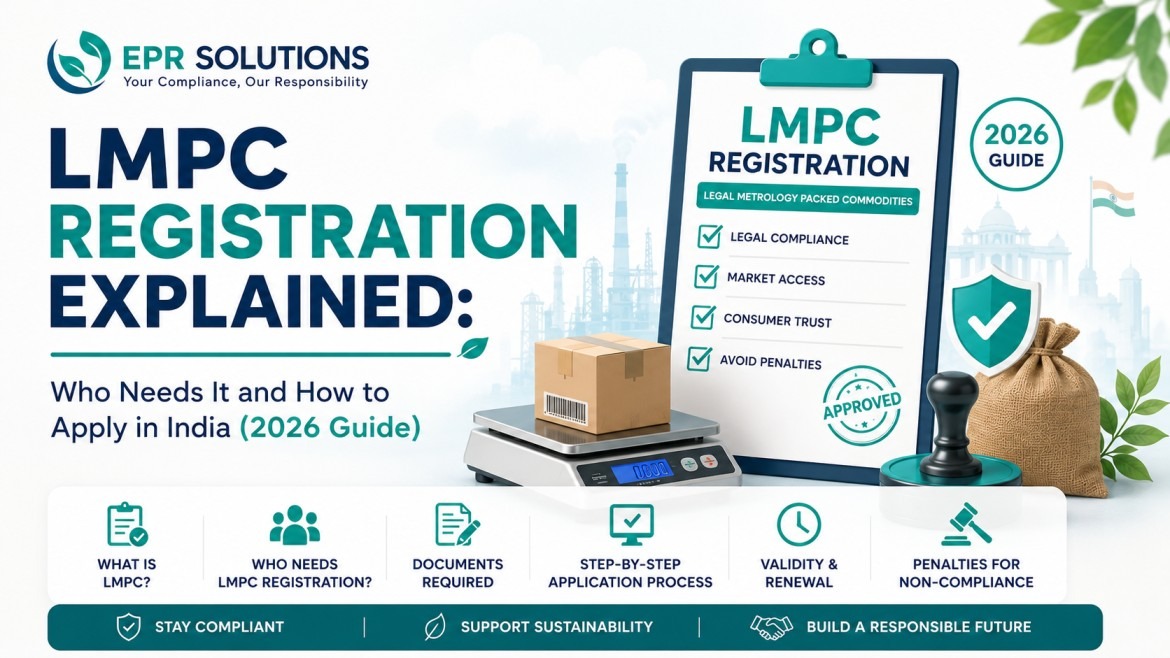
If your business imports, manufactures, or packs goods that are sold in pre-packaged form in India, LMPC registration is not optional. It is a statutory requirement under the Legal Metrology Act, 2009, enforced by customs authorities at ports of entry and by Legal Metrology Officers in the market. Missing or incorrect compliance has stopped shipments, triggered penalties, and caused product seizures — consequences that are entirely avoidable with proper registration and labeling.
This guide covers everything you need to know: what LMPC registration is, which businesses must obtain it, what mandatory declarations must appear on every package, how to apply online, what documents are required, how much it costs, and what happens if you fail to comply.
What is LMPC registration?
LMPC stands for Legal Metrology Packaged Commodities. LMPC registration is the formal enrollment process under the Legal Metrology (Packaged Commodities) Rules, 2011, through which manufacturers, packers, and importers of pre-packaged goods register with the Legal Metrology Department before offering products for sale or distribution in India.
The registration is sometimes referred to as an "importer's licence," "Legal Metrology Certificate," or "importer registration under Rule 27" — all of these terms refer to the same compliance requirement. The certificate issued at the end of the registration process is what customs officers and market surveillance inspectors ask to see when verifying that pre-packaged commodities meet Indian legal standards.
The governing framework consists of two primary instruments:
- The Legal Metrology Act, 2009 — the primary statute that establishes standards for weights, measures, and pre-packaged commodity requirements across India.
- The Legal Metrology (Packaged Commodities) Rules, 2011 — the subordinate rules that specify exactly what declarations must appear on every pre-packaged commodity label, and the registration obligations for manufacturers, packers, and importers.
The Department of Consumer Affairs under the Ministry of Consumer Affairs, Food and Public Distribution administers both. The Legal Metrology Department in each state enforces them on the ground.
Key distinction: LMPC registration is not a product-level approval. It is a business-level registration that authorizes the registrant — an importer, manufacturer, or packer — to deal in pre-packaged commodities from their registered premises. A single registration can cover multiple product categories handled from the same location.
Who needs LMPC registration?
Three categories of business are required to obtain LMPC registration before selling or distributing pre-packaged commodities in India.
1. Importers of pre-packaged goods
This is the most time-sensitive category. Under Rule 27 of the Legal Metrology (Packaged Commodities) Rules, 2011, and Section 19 of the Legal Metrology Act, 2009, importers must obtain LMPC registration before their goods are cleared from customs. Customs authorities are empowered to and routinely do detain shipments where LMPC documentation is missing. An importer who attempts to clear pre-packaged goods without valid registration faces not just delay but potential seizure and fines.
The registration requires importers to declare in advance which categories of pre-packaged products they intend to import. Any product category introduced after registration must typically be updated or added through the relevant authority.
2. Manufacturers of pre-packaged commodities
Any business that produces a commodity and packages it for retail sale without the purchaser being present — from food processors to consumer electronics assemblers to cosmetics producers — must hold LMPC registration. The registration confirms that the entity is aware of and compliant with the mandatory labeling declarations that must accompany every unit leaving their facility.
3. Packers of pre-packaged commodities
A packer is a business that packages commodities manufactured by others for retail sale. Contract packers, co-packers, and private label operators fall into this category. Even though they are not the original manufacturer, they are legally responsible for ensuring that every package they produce complies with LMPC labeling requirements.
E-commerce sellers
Online marketplaces such as Amazon, Flipkart, and Meesho require sellers to hold valid LMPC registration for pre-packaged products listed on their platforms. Platforms may suspend seller accounts or delist products if valid LMPC documentation cannot be furnished upon request. For businesses that sell directly through their own website, the same requirement applies — the product at the point of delivery must carry all mandatory LMPC declarations.
Mandatory label declarations under Rule 6
The most operationally critical aspect of LMPC compliance for most businesses is not the registration itself but ensuring that every package leaving the facility or port of entry carries all the declarations mandated under Rule 6 of the Legal Metrology (Packaged Commodities) Rules, 2011. Non-compliant labeling is one of the most common triggers for product seizure and penalties in market surveillance.
Every pre-packaged commodity sold in India must bear the following declarations in a clear, legible, and non-removable manner:
- Name and address of the manufacturer, packer, or importer — including street address, city, state, and PIN code
- Name of the commodity — both the brand name and the generic description of the product
- Net quantity — declared in standard units (grams, kilograms, millilitres, litres, or count as appropriate); net quantity must be accurate within prescribed error tolerances
- Month and year of manufacture or packing — the date must be printed on the package (not just on an applied sticker)
- Best before or expiry date — where applicable (food, beverages, pharmaceuticals, certain cosmetics)
- Maximum Retail Price (MRP) — inclusive of all taxes, clearly stated as "MRP ₹ [amount] (incl. of all taxes)"
- Country of origin — mandatory for imported goods
- Consumer care contact — name, address, and telephone number of the entity responsible for consumer grievances
- Importer Exporter Code (IEC) — for imported products
- Common or generic name of the substance — particularly important for chemical and food products
Labels must be printed directly on the package or on a label securely and permanently affixed. Removable stickers, handwritten additions, or labels applied over the original foreign packaging to cover non-compliant information are not acceptable. Customs inspectors are trained to look for overlay labels masking missing or incorrect declarations.
For imported goods, this means that either the original overseas packaging must include all Indian mandatory declarations, or the importer must apply a compliant Indian label at the point of import — typically at a customs-bonded warehouse — before the goods clear into the domestic market.
Which products are exempt from LMPC rules?
Rule 26 of the Legal Metrology (Packaged Commodities) Rules, 2011 specifies categories of packages that are exempt from the requirements of the Rules. Understanding these exemptions prevents unnecessary compliance overhead for products that do not require LMPC labeling.
Key exemptions include packages where the net quantity is 10 grams or 10 millilitres or less; agricultural products sold in quantities above 50 kilograms (such as bulk rice or wheat sacks sold industrially); non-retail industrial packages above 25 kilograms or 25 litres intended for use in manufacturing or processing (not retail); fast food items packed at a restaurant or hotel for immediate consumption; and packages accompanied by a pre-printed invoice where the package itself is part of an institutional supply chain rather than retail sale.
The Third Amendment to the LMPC Rules (notified August 2022, effective January 2023) added a further exemption for loose or open garments and hosiery items under specific conditions set out in the amended Rule 26.
If you are unsure whether your specific product category qualifies for an exemption, verification with the Legal Metrology Department or a compliance consultant is advisable before assuming exemption applies. Acting on an incorrect exemption assumption exposes businesses to the same enforcement risk as outright non-registration.
Types of LMPC registration
Importer Registration (Rule 27)
Mandatory for any business importing pre-packaged commodities into India. Often called the "Importer's Licence" or "LMPC Certificate for Import." Must be obtained before the first shipment is cleared from customs. This is the registration type most commonly required by customs authorities and e-commerce platforms.
Manufacturer Registration
Required for businesses that manufacture pre-packaged commodities at their own facilities for sale or distribution. Registration is premises-linked and must be obtained for each manufacturing location. The manufacturing permit confirms the entity understands and will comply with mandatory declaration requirements on all outgoing packaged goods.
Packer Registration
Required for entities that pack commodities manufactured by others for retail sale. Contract packers and private label operators who source product from one party and package it for another party's brand must hold packer registration. Both the manufacturer and packer bear responsibility for label compliance on the final retail unit.
Documents required for LMPC registration
The document set for LMPC registration is broadly consistent across states, though specific requirements can vary. The following list covers the core documents required in nearly all states for importer, manufacturer, and packer registration.
Business identity documents
- Certificate of Incorporation (for companies) or Partnership Deed (for firms) or Declaration of Proprietorship (for sole proprietors)
- PAN card of the business entity
- GST registration certificate
- Board resolution or authorization letter designating the authorised signatory (for companies)
- Identity and address proof of the authorized signatory (Aadhaar, passport, or voter ID)
Premises and operational documents
- Proof of business premises — registered rent agreement, lease deed, or ownership document
- Utility bill (electricity, water) in the name of the business or address proof for the premises
- Factory licence or industrial registration (for manufacturers, if applicable)
Import-specific documents
- Import Export Code (IEC) certificate — mandatory for importers; issued by DGFT
- Details of products to be imported — commodity name, category, net quantity range, and packaging type
- Sample label designs for each product category, showing all mandatory Rule 6 declarations
Product and label information
- Product list with descriptions, generic names, and declared net quantities
- Sample label artwork — printed or digital — demonstrating compliance with all Rule 6 mandatory declarations
- Details of the consumer care contact to be printed on packaging
Label review before submission: Authorities scrutinize submitted label samples carefully. Incomplete labels — even if the application form is otherwise correct — are a common reason for rejection or delay. Having a compliance expert review label artwork against the full Rule 6 checklist before submission significantly reduces rejection risk.
How to apply for LMPC registration: step-by-step
The application process is increasingly digital in 2026, with most states accepting online filings through the central government portal or the National Single Window System. Some states have their own portals with slightly different workflows.
Assess your product scope
Identify all pre-packaged commodities your business imports, manufactures, or packs. Determine which fall under LMPC Rules and which, if any, qualify for exemption under Rule 26. Create a comprehensive product list — this forms the basis of your application.
Prepare and audit your label artwork
For each product category, prepare label designs that include every mandatory declaration under Rule 6. Verify that the MRP includes all applicable taxes, net quantity uses correct standard units, and all address and contact information is accurate. This step deserves careful attention — non-compliant labels submitted with the application will result in rejection.
Compile the document set
Gather all required documents as listed above. For importers, ensure your IEC is current and active. Prepare digital copies in the format required by the portal (typically PDF, under specified file size limits).
Submit the application online
Access the government Legal Metrology portal at lm.doca.gov.in or the National Single Window System (nsws.gov.in). Create an account using your business credentials, select the relevant registration type (importer, manufacturer, or packer), fill in the application form, upload all required documents and label samples, and pay the applicable government fee (approximately ₹500 for most states). A few states still accept offline applications — verify this with the relevant State Legal Metrology Department if required.
Facilitate document verification and inspection
After submission, a Legal Metrology Officer reviews your application and documents. For manufacturer and packer registrations, a physical inspection of the premises is typically required to verify that the facility is operational and capable of maintaining the records required under the Rules. Cooperate promptly with inspection requests and provide any additional documentation requested — delays in responding extend the processing timeline.
Receive and activate your LMPC certificate
Upon successful verification, the Legal Metrology Department issues the LMPC registration certificate — digitally through the portal. Download and retain the certificate. For importers, this certificate must be presented to customs authorities when clearing packaged goods. The registration number should be maintained in your compliance records and referenced in any regulatory correspondence.
Processing typically takes 7 to 20 working days from the date of a complete application submission, depending on the state and current application volumes. Applications with document deficiencies or non-compliant labels take significantly longer.
LMPC registration fees and validity
The government registration fee for LMPC is typically around ₹500, making it one of the lower-cost statutory registrations in India's regulatory landscape. However, total costs including professional documentation preparation, label compliance review, and state-specific charges can range from ₹5,000 to ₹25,000 depending on the complexity of the product portfolio and the state in which registration is sought.
LMPC registration is valid for five years from the date of issue in most states, though some issuing authorities grant certificates with validity between one and five years. Renewal must be initiated before the expiry date. Operating with a lapsed LMPC certificate carries the same legal risk as operating without any registration — it does not provide a grace period.
Renewal process
LMPC renewal broadly follows the same process as initial registration: updated documents are submitted (including renewed IEC if applicable), the current label designs are confirmed or revised, and the renewal fee is paid through the portal. Key documents specifically required for renewal include the previously issued LMPC certificate, current GST registration, updated IEC (for importers), and any revised label samples reflecting changes in the product portfolio or mandatory declaration requirements introduced since the original registration.
Initiating renewal at least 60 to 90 days before expiry is advisable — this provides adequate buffer for document queries, inspection scheduling, or processing backlogs without creating a compliance gap.
Penalties for non-compliance
The Legal Metrology Act, 2009 prescribes a tiered penalty structure for different violations. For businesses dealing with pre-packaged commodities, the most relevant provisions are:
Manufacturing, packing, importing, or selling pre-packaged commodities with error in net quantity can attract a fine of not less than ₹10,000 and up to ₹50,000. For repeat offences, the penalty increases to a fine of up to ₹1,00,000 and imprisonment of up to one year, or both. Directors of a company bear personal liability unless another named officer has been specifically designated as responsible.
Customs authorities operate under Section 19 of the Legal Metrology Act and can refuse clearance of imported pre-packaged goods if LMPC registration is absent or expired. Beyond the fine risk, the cost of demurrage, storage, re-labelling, and logistics disruption from a detained shipment typically far exceeds the cost of obtaining proper registration in advance.
State Legal Metrology Officers conduct market surveillance and can seize products found without valid LMPC documentation or with non-compliant labels. Seized goods may be destroyed, returned to the importer at cost, or held until compounding fees are paid. Market seizures are visible, damaging to brand reputation, and often result in media coverage.
Amazon, Flipkart, Meesho, and other major e-commerce platforms actively request LMPC certificates for pre-packaged product listings. Sellers who cannot produce a valid certificate may have listings suspended or accounts restricted. Reinstatement requires furnishing the certificate, with no guarantee of immediate restoration of listing visibility or rankings.
An amendment to the Legal Metrology Act was tabled before Lok Sabha in August 2025 proposing to decriminalize certain labelling-related offences. However, as of the date of this guide, Section 36 (non-standard packages) remains unchanged and still carries the possibility of imprisonment for repeat offences. Businesses should not rely on proposed amendments as current law until formally enacted and notified in the Official Gazette.
Common LMPC compliance mistakes to avoid
Based on patterns in Legal Metrology enforcement and customs detentions, the following mistakes account for a disproportionate share of LMPC compliance failures.
Applying the wrong importer name. The name and address on the product label must exactly match the name of the LMPC-registered importer. If a business trades under a brand name but is registered as a legal entity under a different name, the label must carry the registered legal entity name — not the brand name — as the importer of record. Mismatch between label and registration is a common customs flag.
Incorrect MRP declaration. The MRP must include all applicable taxes, including GST, and be stated in the prescribed format ("MRP ₹ [amount] incl. of all taxes"). Stating a price exclusive of taxes, or omitting the MRP entirely for non-exempt goods, is a violation under both LMPC Rules and the Consumer Protection Act.
Net quantity stated in non-standard units. Quantities must be expressed in metric units. Declaring weight in pounds, volume in fluid ounces, or dimensions in inches on the primary label is non-compliant, even if the foreign original packaging uses those units.
Relying on overlay stickers without re-labelling strategy. Applying a sticker over non-compliant foreign labels is a commonly attempted but legally risky approach. Authorities view sticker-over labels with heightened suspicion, and a sticker that can be removed or that partially obscures the original label will fail inspection. A clear, permanent, appropriately sized Indian label applied at an authorized re-labelling facility is the compliant approach.
Failing to update registration after changing product portfolio. If an importer adds a new product category not covered by their existing LMPC registration, they must update or amend their registration before importing that new category. Importing a category not listed in the registration is treated as importing without registration for that product type.
LMPC compliance for e-commerce and D2C businesses
The intersection of LMPC compliance and e-commerce warrants particular attention as direct-to-consumer businesses scale. The Legal Metrology (Packaged Commodities) Rules apply equally to goods sold online as to goods sold through physical retail — the medium of sale does not affect the statutory labeling obligations.
For D2C importers, this means that product pages on their website must not show prices different from the MRP declared on the physical package. If pricing is updated due to exchange rate changes or GST revisions, the physical labels on stock already in warehouse must be brought into alignment before shipment to customers — not just the website price.
For marketplace sellers, most platforms now run automated compliance checks and require LMPC certificate numbers when listing pre-packaged product categories. Amazon India's seller compliance programme, for example, requires LMPC documentation for categories including food, health supplements, beauty, and electronics. Non-compliant listings are increasingly proactively taken down by platform compliance teams rather than only on complaint.
LMPC registration vs. BIS certification: understanding the difference
A question that frequently arises among importers managing multiple compliance obligations is how LMPC registration relates to BIS (Bureau of Indian Standards) certification. These are entirely separate requirements with different governing bodies, different purposes, and different product scopes.
LMPC registration governs how pre-packaged goods are labeled and declared — it is about packaging compliance, quantity accuracy, and consumer information. BIS certification, governed by the Bureau of Indian Standards Act, 2016, is about product safety and quality standards — it certifies that specific product categories meet defined technical standards (IS standards). Many product categories require both: for example, an importer of packaged electronic goods may require BIS CRS (Compulsory Registration Scheme) certification for the product and LMPC registration for the packaging.
Having one does not substitute for the other. Maintaining both registrations and ensuring they are current is part of the complete compliance picture for regulated imported goods.
Final thoughts
LMPC registration is one of the less complicated statutory requirements in India's regulatory landscape — the government fee is modest, the online application process is accessible, and the documentation set is manageable for businesses with organized records. What makes it consequential is the enforcement mechanism: customs authorities do stop shipments, and Legal Metrology Officers do conduct market raids. The cost of non-compliance — in detained goods, fines, and reputational damage — is dramatically higher than the cost of getting registration right the first time.
The most common compliance failures are not about registration itself but about labeling — incorrect MRP declarations, missing mandatory fields, non-standard quantity units, and improper overlay labels. Treating LMPC compliance as a labeling discipline rather than a one-time registration task is the mindset that produces sustained compliance.
As India's consumer protection framework continues to tighten — with the proposed amendments to the Legal Metrology Act and increased digital integration of port-level and market-level surveillance — LMPC compliance will only attract more rigorous enforcement attention in 2026 and beyond.
Need help with LMPC registration or label compliance?
Our team assists importers, manufacturers, and packers across India with LMPC registration, label audits, Rule 6 compliance review, and renewal — so your products clear customs and reach the market without compliance interruptions.
Talk to an expertFrequently Asked Questions
LMPC stands for Legal Metrology Packaged Commodities. LMPC registration is the mandatory compliance process under the Legal Metrology Act, 2009 and the Legal Metrology (Packaged Commodities) Rules, 2011, that requires manufacturers, packers, and importers of pre-packaged goods to register with the Legal Metrology Department before selling or distributing those goods in India. The registration confirms compliance with statutory packaging and labeling standards designed to protect consumers from incorrect quantity declarations, misleading pricing, and missing product information.
Three categories of business must obtain LMPC registration: importers who bring pre-packaged goods into India for sale or distribution (required before customs clearance under Rule 27); manufacturers who produce pre-packaged commodities for sale; and packers who package goods manufactured by others for retail sale. E-commerce sellers listing pre-packaged products on platforms like Amazon or Flipkart are also required to hold valid LMPC registration, as most platforms actively verify this before permitting certain product category listings.
Core documents include: Certificate of Incorporation or Partnership Deed or proprietorship declaration, PAN card of the business, GST registration certificate, Import Export Code (IEC) for importers, proof of business premises, identity and address proof of the authorized signatory, sample product labels showing all mandatory Rule 6 declarations, and a product list with categories and net quantity ranges. Manufacturers may additionally need factory licences and state-specific operational authorizations. Document requirements can vary slightly by state and application type.
The government fee for LMPC registration is typically around ₹500. However, total costs including professional assistance with documentation preparation, label compliance review, and state-specific charges generally range from ₹5,000 to ₹25,000 depending on the state, business type, and the complexity of the product portfolio being registered.
LMPC registration is typically valid for five years from the date of issue, though some state authorities issue certificates with validity ranging from one to five years. Renewal must be initiated before the expiry date — operating with a lapsed registration carries the same legal risk as operating without registration. Initiating renewal 60 to 90 days before expiry is recommended to allow time for any document queries or processing delays.
Under Rule 6 of the LMPC Rules, 2011, mandatory declarations on every pre-packaged commodity include: name and address of the manufacturer, packer, or importer; the generic commodity name; net quantity in standard units; month and year of manufacture or packing; Maximum Retail Price (MRP) inclusive of all taxes; country of origin for imported goods; consumer care contact details; and the Importer Exporter Code (IEC) for imported products. Labels must be permanent, legible, and prominently displayed — removable stickers applied over non-compliant foreign labels are not an acceptable compliance strategy.
Under Rule 26, key exemptions from LMPC Rules include: packages with net quantity of 10 grams or 10 millilitres or less; agricultural products sold in bulk quantities above 50 kilograms; non-retail industrial packages above 25 kilograms or 25 litres; fast food items packed at a restaurant or hotel for immediate consumption; and institutional supply packages accompanied by a pre-printed invoice. If your product might qualify for an exemption, verify applicability with the Legal Metrology Department or a qualified compliance advisor before treating it as exempt.
Consequences of non-compliance include: customs detention or refusal of clearance for imported goods; seizure of products in the market by Legal Metrology Officers; fines under Section 36 ranging from ₹10,000 to ₹1,00,000; imprisonment of up to one year for repeat offences; and suspension of e-commerce seller accounts. Indirect costs — demurrage, re-labelling, logistics disruption, and reputational damage from public seizures — typically exceed the direct penalty amounts.
Yes. LMPC registration is issued to the importer, manufacturer, or packer for their registered business premises — not for individual products or SKUs. A single registration can cover multiple pre-packaged commodity categories handled from the same premises. However, the application must list all product categories intended to be covered, and each product's labeling must individually comply with Rule 6 mandatory declarations. Adding a new category not covered in the original registration requires an amendment or update to the registration before importing or selling that category.
LMPC registration can be applied for online through the Legal Metrology portal at lm.doca.gov.in (under the Department of Consumer Affairs) or through the National Single Window System at nsws.gov.in. Create an account, select the applicable registration type, fill in the application form with business and product details, upload the required documents including label samples, and pay the government fee. Some states have their own portals in addition to or instead of the central portal — verify with your state Legal Metrology Department if needed. Processing typically takes 7 to 20 working days for complete applications.