
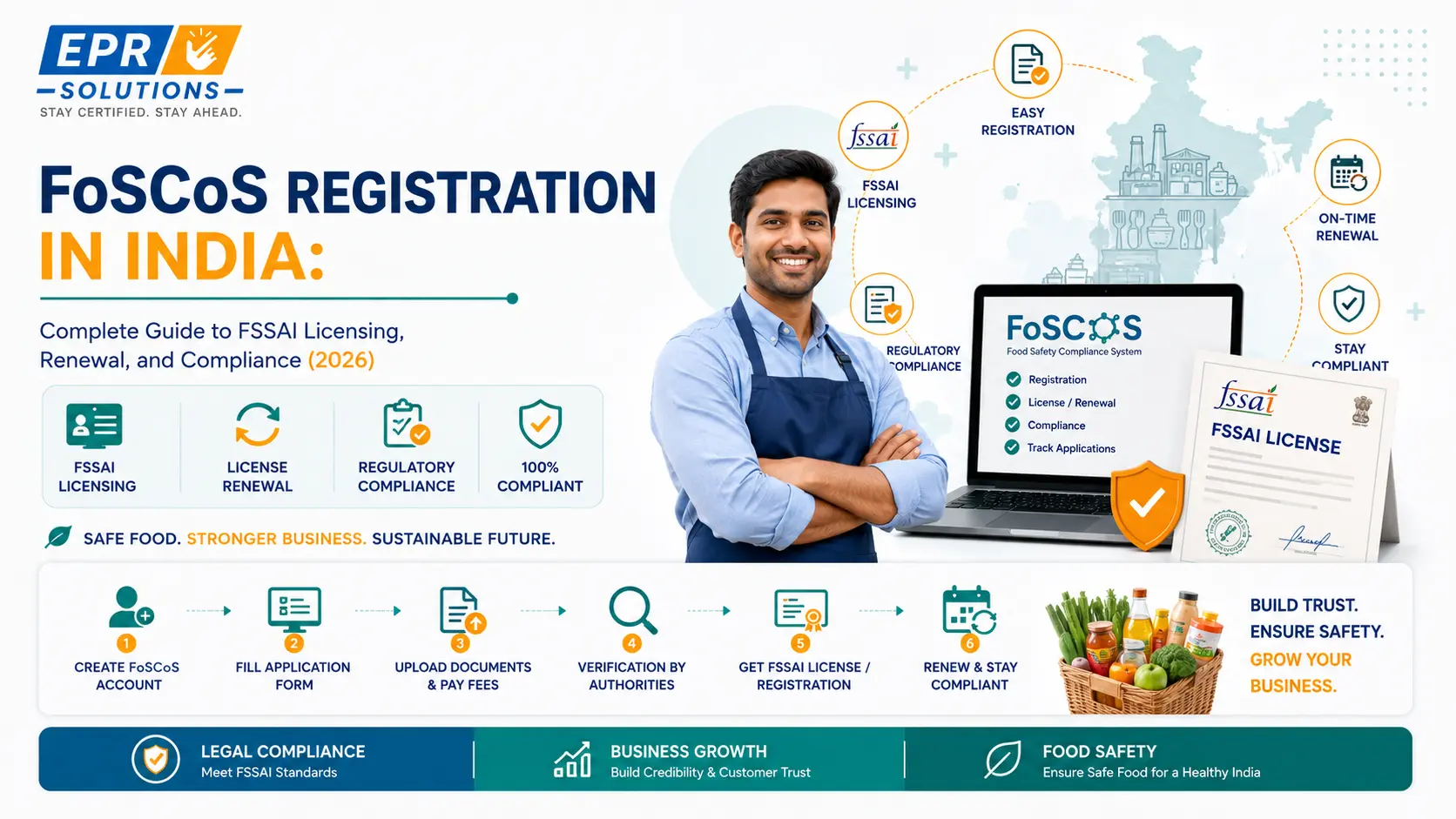
Every food business in India — from a home baker taking orders on Instagram to a multi-state manufacturing plant — has to be registered with the Food Safety and Standards Authority of India (FSSAI) before it can legally sell, store, or distribute food. Since 2020, that entire process runs through one portal: FoSCoS, the Food Safety Compliance System. If you've landed here because you're not sure whether you need Basic Registration or a full licence, how much it costs, or what to do about a licence that's about to lapse, this guide walks through the whole system end to end.
FoSCoS replaced the older Food Licensing and Registration System (FLRS) and now handles new applications, renewals, modifications, annual returns, and even food recall reporting in a single online workflow. The underlying rules haven't changed — FSSAI registration and licensing are still governed by the Food Safety and Standards Act, 2006 — but the portal has made it faster to apply and easier to track where an application stands. Below, we cover which category your business falls into, exactly what to prepare before you start the form, the fees and validity periods involved, and the renewal deadlines that catch the most food business operators off guard.
What is FoSCoS?
FoSCoS stands for Food Safety Compliance System. It's the official online platform operated by FSSAI — the apex food regulator under India's Ministry of Health and Family Welfare — for registering, licensing, renewing, and managing compliance for every Food Business Operator (FBO) in the country. Before FoSCoS, the process ran through FLRS, a system that was widely criticised for slow processing and inconsistent tracking across states. FoSCoS launched to centralise that workflow, tighten document verification, and give applicants real-time visibility into their application status.
Every FBO, regardless of size, is expected to hold a valid 14-digit FSSAI registration or licence number, and that number is meant to appear on packaging, invoices, and at the business premises. Whether you run a single food stall or a factory exporting processed foods, FoSCoS is where that number gets issued, renewed, and updated.
Worth knowing: FoSCoS is a portal, not a separate approval in itself. Your business still needs Basic Registration, a State Licence, or a Central Licence under the Food Safety and Standards Act, 2006 — FoSCoS is simply where you apply for it, renew it, and manage it going forward.
What can you do on the FoSCoS portal?
New registration or licence
Apply for Basic Registration, a State Licence, or a Central Licence by filing Form A or Form B online, depending on your turnover and business activity.
Renewal
Renew an existing registration or licence before it lapses, choosing a fresh validity period of anywhere from 1 to 5 years.
Modification
Update your business address, product or food category list, or the names of directors and partners without filing a brand-new application.
Annual returns
File Form D1 — or Form D2 for dairy businesses — to report what you manufactured, imported, or handled over the financial year.
FSSAI registration vs. FSSAI licence: what's the difference?
People often use "FSSAI registration" as a catch-all term, but the Food Safety and Standards Act, 2006 actually treats registration and licensing as two distinct approvals. Basic Registration is the lighter-touch option, meant for small food businesses under a turnover threshold, and it asks for relatively simple documentation. A licence — issued at either the State or Central level — is required once a business crosses that threshold, and it comes with a heavier documentation load, including a layout plan of the premises and, in many cases, a physical inspection before approval.
The distinction matters beyond paperwork, too. It typically determines how quickly your application is processed, what happens if you miss a renewal deadline, and whether you're required to file an annual return. Getting this classification right at the outset is one of the more consequential decisions in the whole process, since operating under the wrong category is itself a compliance gap.
Basic, State, or Central: choosing the right FSSAI category
FSSAI sorts food businesses into three categories, primarily based on annual turnover, though certain manufacturing activities are governed by production capacity instead. Here's how the three compare:
| Category | Who it's for | Form | Typical annual fee | Processing time |
|---|---|---|---|---|
| Basic Registration | Turnover up to ₹12 lakh a year — home kitchens, small food stalls, hawkers, petty manufacturers | Form A | ≈ ₹100 | 3–7 days (Tatkal: ~48 hrs) |
| State Licence | Turnover between ₹12 lakh and ₹20 crore — most restaurants, mid-sized manufacturers, hotels, distributors | Form B | ₹2,000–₹5,000 | 30–60 days |
| Central Licence | Turnover above ₹20 crore, importers, exporters, e-commerce FBOs, or operations spanning multiple states | Form B | ≈ ₹7,500 | 30–60 days |
If you manufacture food: turnover isn't the only factor. Dairy units, vegetable-oil processing units, meat-processing units, and grain-milling units are governed by production capacity thresholds as well — so a low-turnover manufacturer can still be pushed into a State or Central licence based on installed capacity alone. Confirm your category against the capacity limits for your Kind of Business, not just your sales figures.
Documents required for FoSCoS registration
Documentation scales with the category you're applying for. Every application needs a common core; State and Central applications ask for a good deal more on top of that.
Required for every category:
- Passport-size photograph of the proprietor or authorised signatory
- Government-issued photo ID — Aadhaar card, PAN card, voter ID, passport, or driving licence
- Proof of business premises — a rent or lease agreement with the owner's NOC, or an ownership document or utility bill if the premises is owned
- List of food products or categories the business deals in
- Declaration of a Food Safety Management System (FSMS) plan
Additional documents for a State or Central licence:
- Completed Form B, signed by the proprietor, partner, or authorised signatory
- Layout plan of the processing unit or business premises
- List of directors, partners, or executive members with their ID and address proof
- Equipment and machinery list, for manufacturers
- Water test report, mandatory wherever water is used as an ingredient
- NOC from the local municipal or health authority, where applicable
Additional documents for a Central licence:
- Import Export Code (IEC), issued by the DGFT, for importers and exporters
- Turnover proof — audited financial statements or a CA certificate
- Form IX — nomination of a responsible person, backed by a board resolution for companies
- Food recall plan, outlining how products would be retrieved in the event of a safety issue
- Geo-tagged photographs of the business premises
Step-by-step: how to register on FoSCoS online
Create your FoSCoS account
Go to the official FoSCoS portal, foscos.fssai.gov.in, and click "Sign Up." Enter your mobile number and email address, then verify both with the OTPs sent to you.
Choose registration or licence
Select whether you're applying for Registration or a Licence, and choose your state. The portal will suggest a category once you've entered your expected annual turnover.
Select your Kind of Business (KoB) carefully
This single selection decides your document checklist and your license category. Picking the wrong KoB is one of the most common reasons applications get rejected or sent back for correction.
Fill in Form A or Form B
Enter your business name, constitution (proprietorship, partnership, company, etc.), premises address, and the specific food categories you handle.
Upload your documents
Attach scanned copies — ideally under 1 MB each, in PDF format — as per the checklist the portal generates based on your chosen category and KoB.
Pay the government fee
Pay for anywhere from 1 to 5 years upfront. The total is simply the annual fee multiplied by the number of years — there's no instalment option, and the fee is non-refundable once submitted.
Track your application
A Designated Officer reviews the filing. State and Central licence applications may also involve a physical inspection of your premises before approval.
Download your certificate
Once approved, your registration certificate or licence — carrying your unique 14-digit FSSAI number — becomes available to download directly from the portal.
Many applicants for Basic Registration can use the Tatkal (fast-track) option, which is typically processed within about 48 hours of payment and digital verification — useful if you need to start operating quickly and your documentation is straightforward.
Logging in to FoSCoS
Once you have a registration or licence number, you can log in to check your application status, download a duplicate certificate, or begin a renewal. On the FoSCoS login page, click "FBO Login," enter your registration or licence number as your user ID along with your password and the captcha shown, then submit. If you've forgotten your password, use the "Forgot Password" option on the login page to reset it via your registered mobile number or email.
Most small food business operators don't need to log in often after their initial approval — the login is used more actively to track renewal deadlines, file Form D1 or D2 annual returns, or make modifications such as an address or product-list update.
FSSAI licence fees and validity period
Registration and licences under FoSCoS can be issued for any period from 1 to 5 years, chosen by the applicant at the time of filing. The fee is calculated as the annual rate for your category multiplied by the number of years you select, paid in full at the time of application — there's no option to pay in instalments.
A practical trade-off worth weighing: choosing the maximum 5-year validity doesn't change the annual government fee, but it does mean one application instead of five, and one renewal deadline to track instead of an annual one. For a business with tight cash flow in its early stages, though, a shorter validity with a lower upfront payment may be the more manageable choice.
Renewing your FSSAI licence or registration
The renewal window on FoSCoS opens well in advance — you can typically file as early as 180 days before your current licence expires, and the renewal option usually becomes visible on your FoSCoS dashboard around 120 days out. FSSAI recommends completing the renewal at least 30 days before expiry, since that's the point at which a late fee starts to apply.
Missed the 30-day window? A late fee of roughly ₹100 per day is commonly applied once you're past the 30-day pre-expiry mark, calculated from the date you're late rather than the date of expiry. If a licence has already expired and stays lapsed for an extended period, FSSAI may require a completely fresh application rather than a straightforward renewal — so it's worth treating an expiring licence as a hard deadline rather than a soft one.
The renewal fee itself is identical to the original registration or licence fee for whatever new term you choose. To avoid last-minute scrambling, it helps to set reminders at 90, 60, and 30 days before expiry, and to keep your registered email current on FoSCoS so the portal's automatic renewal notifications actually reach you.
FSSAI annual returns: Form D1 and Form D2
Separate from renewal, some FBOs also have an annual filing obligation. Form D1 is due by 31 May each year, covering the previous financial year, and applies to State and Central licence holders engaged in manufacturing, processing, importing, relabelling, or repackaging food products. Basic Registration holders, and businesses that are purely retail, distribution, or food service — restaurants, canteens, and similar outlets — are generally exempt from Form D1.
Form D2 is a separate half-yearly return specific to businesses manufacturing or handling milk and milk products, filed in addition to (or instead of) Form D1 depending on the business activity.
Late filing of Form D1 commonly attracts a fine calculated per day of delay, in line with the penalty structure set out in the Food Safety and Standards (Licensing and Registration of Food Businesses) Regulations, 2011. Because exemptions are tied to your specific business activity rather than a blanket rule by category, it's worth confirming your exact filing obligation on FoSCoS rather than assuming your business is exempt.
Penalties for operating without a valid FSSAI licence
Section 63 of the Food Safety and Standards Act, 2006 addresses food businesses operating without the registration or licence they're required to hold. Historically, this carried a penalty of imprisonment for up to 6 months along with a fine of up to ₹5 lakh. Following the Jan Vishwas (Amendment of Provisions) Act, 2023, a number of offences under the FSS Act — including Section 63 — were reworked to reduce reliance on criminal proceedings, and several compliance and legal sources now describe this offence as carrying a monetary penalty rather than imprisonment in many cases. This isn't legal advice, and how these amended provisions are applied can vary; if you're dealing with an active compliance notice, it's worth speaking with a lawyer or compliance professional about your specific situation rather than relying on a general summary.
Beyond the core registration requirement, a licensed business that falls out of compliance — through unhygienic manufacturing conditions, mislabelled products, or food that turns out to be unsafe — faces separate and often steeper penalties under other sections of the Act, and a continuing offence can attract an additional daily fine on top of the base penalty. Holding a valid licence is the starting point for compliance, not the end of it.
Common mistakes to avoid during FoSCoS registration
Your KoB selection determines your document checklist and your license category. Getting it wrong often means starting the application over from scratch.
Dairy, meat, vegetable-oil, and milling units are governed by production capacity thresholds as well as turnover. Check both before assuming Basic Registration is enough.
Most Designated Officers expect at least six months of remaining validity on a lease at the time of application. An agreement expiring soon is a common, avoidable cause of rejection.
Missing it means paying a daily late fee on top of the renewal fee itself, and a prolonged lapse can mean reapplying from scratch instead of simply renewing.
Form D1 obligations are tied to business activity, not category alone. Confirm your specific filing requirement on FoSCoS rather than assuming exemption.
Final thoughts
FoSCoS collapses what used to be a scattered, state-by-state paperwork exercise into a single online system, but the categories, documents, and deadlines still require the same attention they always did. Getting the Kind of Business selection right at the outset, keeping your lease and address documentation current, and renewing 30 to 60 days before expiry will keep you out of the two situations that cause the most trouble: a rejected application because the wrong category was chosen, and a lapsed licence that quietly turns a compliant business into one that's technically operating illegally.
If anything about your FoSCoS application is unclear — particularly which category applies to a manufacturing operation, or how to handle a licence that has already expired — a compliance professional familiar with current FSSAI regulations can usually resolve it faster than working through the portal's help documentation alone.
Need help with FSSAI registration or another compliance requirement?
FoSCoS applications are filed directly with FSSAI, but choosing the right licence category, preparing documents correctly, and tracking renewal deadlines is where most businesses lose time. If you'd like support with your FSSAI registration, or need help with GST, MSME/Udyam, or EPR compliance alongside it, our team at EPR Solutions can help.
Talk to our teamFrequently Asked Questions
FoSCoS (Food Safety Compliance System) is FSSAI's official online portal for food business registration, licensing, renewal, modification, and annual return filing in India. It replaced the earlier FLRS system in 2020 and now handles the entire application-to-approval process digitally.
Registration and licence are two separate approvals under the Food Safety and Standards Act, 2006. Basic Registration is for smaller businesses with turnover up to ₹12 lakh a year and involves lighter documentation. A State or Central licence is required above that threshold and involves more extensive documentation, including a business layout plan and, in many cases, a premises inspection.
Basic Registration costs around ₹100 per year. A State licence typically costs between ₹2,000 and ₹5,000 per year depending on your Kind of Business, and a Central licence costs around ₹7,500 per year. You can pay for 1 to 5 years upfront, with the total simply being the annual fee multiplied by the number of years chosen.
At a minimum, you'll need a passport-size photograph, a government-issued photo ID, and proof of your business address. State and Central licence applications additionally require a completed Form B, a layout plan of the premises, a list of food products, and, depending on your business type, a water test report, an equipment list, or an Import Export Code for importers and exporters.
Basic Registration is usually processed within 3 to 7 days, and many applicants can use the Tatkal fast-track option, typically completed within about 48 hours of payment and verification. State and Central licence applications generally take 30 to 60 days, since they may involve document scrutiny and a premises inspection.
Log in to FoSCoS, go to "My Licence/Registration", select the licence you want to renew, and choose Renew. Review your business details, select your new validity period of 1 to 5 years, and pay the renewal fee. Renewal can be filed as early as 180 days before expiry, and it's best to complete it at least 30 days before your licence expires to avoid a late fee.
Operating with an expired licence is treated the same as operating without one under the Food Safety and Standards Act. You can generally still renew after expiry by paying a late fee calculated per day of delay, but if the licence has lapsed for an extended period, you may need to submit a completely fresh application instead of a simple renewal.
Under Section 63 of the Food Safety and Standards Act, 2006, operating a food business without the required registration or licence was historically punishable with imprisonment of up to 6 months and a fine of up to ₹5 lakh. Following the Jan Vishwas (Amendment of Provisions) Act, 2023, this offence has largely been converted into a monetary penalty rather than a criminal one in many cases, so it's worth confirming the current position with a compliance professional if you're dealing with an active notice.
A Central licence is generally required for businesses with an annual turnover above ₹20 crore, food importers and exporters, e-commerce food business operators, and businesses operating across more than one state. Certain manufacturers, such as large dairy, meat, or vegetable oil processing units, may also need a Central licence based on production capacity rather than turnover alone.
Form D1 is FSSAI's annual return, due by 31 May each year for the previous financial year. It applies to State and Central licence holders involved in manufacturing, processing, importing, relabelling, or repackaging food. Basic Registration holders and businesses that are purely retail, distribution, or food service — such as restaurants and canteens — are generally exempt.
Yes. Home-based food businesses, including home bakers and cloud kitchens with turnover up to ₹12 lakh a year, can apply for Basic Registration through FoSCoS using Form A. If turnover grows beyond that threshold, the business will need to upgrade to a State licence.
Log in to the FoSCoS portal with your registration or licence number and password, or use the "Track Application Status" option available without full login access, entering your application reference number to see where your registration currently stands.