
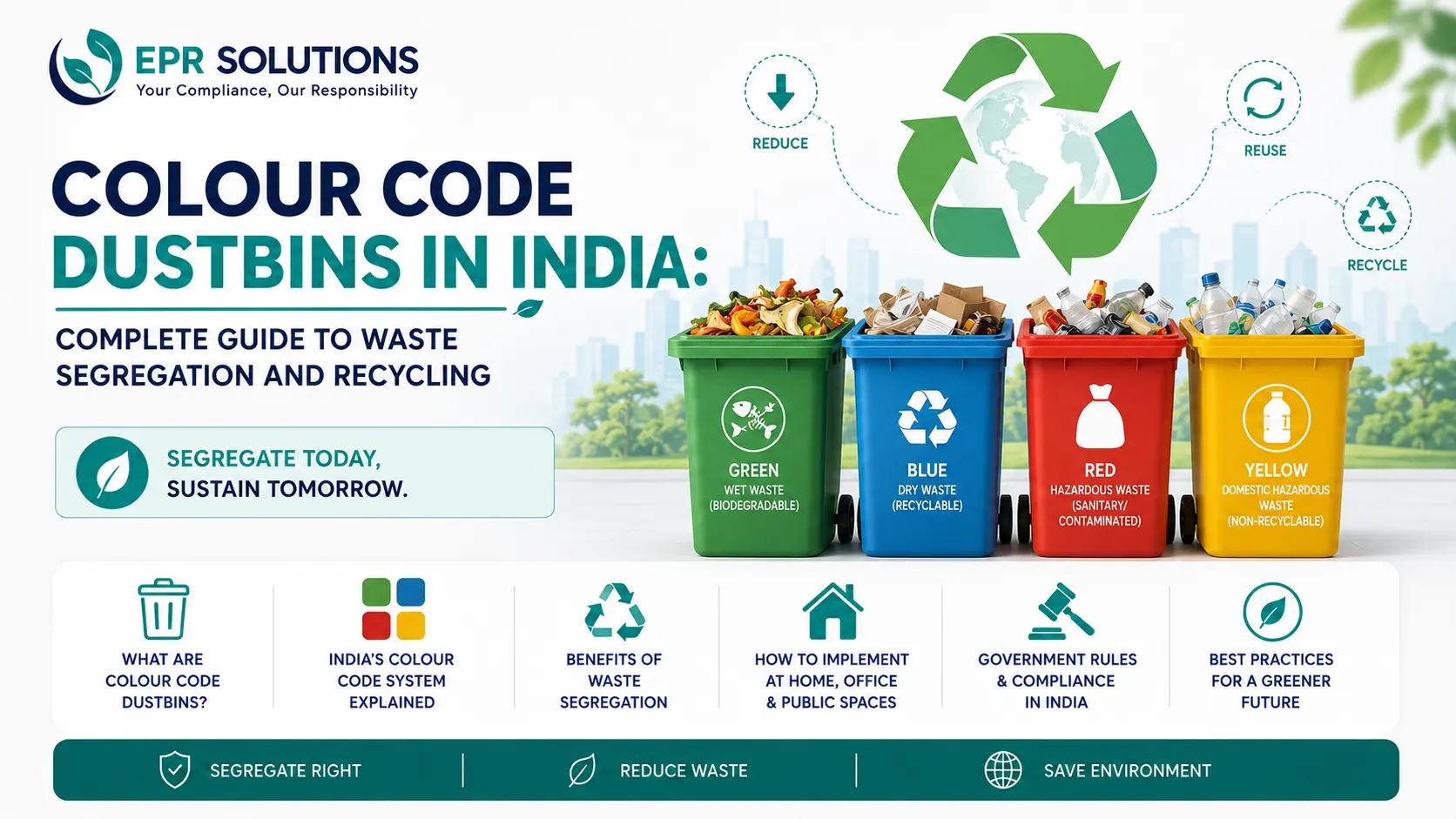
Most people in India can recite the basics: green bin for wet waste, blue bin for dry waste. Fewer know what actually happens after that — which colour handles sanitary waste, where e-waste and batteries are supposed to go, why hospitals use a completely different colour system, or that the entire municipal colour code is being rewritten in 2026. This guide covers all of it, from the bin under your kitchen sink to the compliance obligations your housing society or business may now have.
Waste segregation isn't a courtesy in India — it's a legal requirement under the Solid Waste Management Rules, and non-compliance now carries real financial consequences. Whether you're a household trying to get the colours right, a housing society working out if you qualify as a Bulk Waste Generator, or a business trying to understand where e-waste and battery disposal fit into the picture, this guide walks through the current rules, what's changing, and how to stay compliant.
Quick answer: Green is for wet/biodegradable waste and blue is for dry/recyclable waste everywhere in India. The third colour varies by city and by when your municipal corporation rolls out India's new Solid Waste Management Rules 2026 — it's black in the older three-bin system, and split into red (sanitary) plus a separate special-care stream (batteries, bulbs, expired medicine) under the new four-stream system.
What are colour-coded dustbins, and why does India use them?
Colour-coded dustbins are a source-segregation system: instead of throwing every kind of waste into one bin, households and businesses sort waste by type at the point it's generated, using a standardised colour for each category. The idea is simple — if wet food waste, recyclable dry waste, and hazardous items never get mixed in the first place, each stream can go to the right treatment process instead of ending up compacted together in a landfill.
India formalised this system nationally through the Solid Waste Management Rules, 2016, issued by the Ministry of Environment, Forest and Climate Change, and reinforced it through the Swachh Bharat Mission. Segregation at source became a legal duty for every waste generator — households, shops, offices, and institutions alike — not just a municipal responsibility. In January 2026, the government went a step further, notifying the Solid Waste Management Rules, 2026, which supersede the 2016 framework and introduce a more detailed four-stream colour system, digital compliance tracking, and stricter penalties. We'll cover both systems in detail below, since most Indian neighbourhoods are still transitioning between them.
~170,000 tonnes/day
India's estimated daily municipal solid waste generation, with per-capita generation projected to keep climbing as cities grow.
~1 in 5 tonnes treated
Of the roughly 62 million tonnes of waste India generates annually, only about 12 million tonnes are properly treated before disposal — the rest is landfilled or left uncollected.
~30% from Bulk Generators
Large societies, malls, hotels, hospitals and offices — classified as Bulk Waste Generators — are estimated to produce close to a third of India's total solid waste.
Non-compliance now costs more
Under SWM Rules 2026, landfill fees for unsegregated, mixed waste are structured to exceed the cost of proper segregation and processing — a first for Indian waste policy.
The official household dustbin colour code in India
For everyday household and municipal waste, two colours are consistent nationwide, and a third varies depending on where you live and how far your city has progressed through the 2026 rollout. The table below summarises the current picture.
| Bin colour | Waste type | Typical examples | Where it goes |
|---|---|---|---|
| Green | Wet / biodegradable waste | Food scraps, vegetable and fruit peels, leftover cooked food, tea bags, eggshells, garden and flower waste | Composting or bio-methanation plants |
| Blue | Dry / recyclable waste | Paper, cardboard, clean plastic packaging and bottles, glass, metal cans, tetra packs | Material Recovery Facilities (MRFs) for sorting and recycling |
| Black | Domestic hazardous & sanitary waste | Diapers, sanitary pads, blades, expired medicines, batteries, CFL bulbs, broken thermometers | Separate hazardous-waste handling (being replaced — see below) |
This three-bin model is what most Indian households, RWAs, and municipal collection vehicles have used since 2016, and it's still what you'll encounter in the majority of cities today. If you only remember one rule, make it this one: never mix wet waste with dry waste. A single wet, food-soiled item in a bag of otherwise clean paper and plastic can make the entire batch unrecyclable, and it's the single biggest reason India's recycling rates stay lower than they should be.
For dry waste that includes plastic packaging specifically, it's worth knowing that producers, importers and brand owners of that packaging carry their own compliance obligations under India's plastic waste rules — you can read more about how that works in our guide to Plastic EPR Registration.
SWM Rules 2026: what's changing from the old three-bin system
On January 28, 2026, the Ministry of Environment, Forest and Climate Change notified the Solid Waste Management Rules, 2026, superseding the 2016 rules and coming into force from April 1, 2026. This is the most significant rewrite of India's waste governance in a decade, and it changes the colour-coding picture directly: the old three-stream model (wet, dry, domestic hazardous) becomes a mandatory four-stream model.
| Bin colour | Stream | What goes in | Processing route |
|---|---|---|---|
| Green | Wet waste (unchanged) | Kitchen and food waste, vegetable peels, garden waste | Composting / bio-methanation |
| Blue | Dry waste (unchanged) | Plastic, paper, metal, glass, wood, rubber | Material Recovery Facilities (MRFs) |
| Red | Sanitary waste (new) | Diapers, sanitary pads, tampons, condoms — wrapped and stored separately | Dedicated sanitary-waste collection, kept out of the recycling stream |
| Special care | Hazardous / special care waste (new) | Paint cans, bulbs, mercury thermometers, expired medicines, e-waste, batteries | Collected at designated centres and MRFs, not general street bins |
Two things are worth understanding about this shift. First, splitting the old black bin into a dedicated red sanitary stream and a separate special-care stream directly targets a long-standing contamination problem: sanitary products with plastic composites have been quietly wrecking otherwise clean dry-waste batches for years. Second, the rollout isn't instant — the rules give the largest cities around 18 months, mid-sized cities 24 months, and smaller towns 36 months to fully implement the new infrastructure, with local bodies required to update their bylaws by March 2027. In practice, this means you should treat the colour of the "third bin" as something to confirm locally rather than assume nationally, for the next couple of years at least.
The 2026 rules also formalise a national waste hierarchy — prevention, reduction, reuse, recycling, recovery, and disposal as an absolute last resort — and mandate a centralised online portal run by the Central Pollution Control Board (CPCB) to track registrations, waste audits, and compliance reporting across every urban local body in the country.
Colour code for biomedical waste (hospitals and clinics)
This is where a lot of otherwise good guides on this topic go wrong: biomedical waste from hospitals, clinics, diagnostic labs and veterinary facilities follows a completely different colour framework from household waste, under the separate Bio-Medical Waste Management Rules, 2016 (amended 2018 and 2019). If you've seen conflicting claims online about whether red or yellow means "hazardous," this is usually the reason — people are mixing up two different rulebooks that happen to share some colours.
| Bag / container colour | Category | Typical waste | Treatment |
|---|---|---|---|
| Yellow | Anatomical & infectious waste | Human/animal anatomical waste, soiled dressings, expired or discarded medicines, chemical and lab waste | Incineration, plasma pyrolysis, or deep burial |
| Red | Contaminated recyclable waste | Tubing, bottles, IV sets, urine bags, gloves, syringes (without needles) | Autoclaving or microwaving, then recycling |
| White (translucent) | Sharps waste | Needles, scalpels, blades — puncture-proof, leak-proof containers | Autoclaving or dry-heat sterilisation, then shredding |
| Blue | Glassware & metallic implants | Broken or intact glass ampoules and vials, metallic body implants | Disinfection, then recycling |
The key distinction to remember: this four-colour system applies only inside healthcare and research facilities, and it doesn't apply to household waste at all — even if a household happens to generate the occasional medical item like a used syringe from home diabetes care. Small quantities of home medical waste should still be wrapped securely and, depending on your city's rules, handed to the special-care or domestic-hazardous stream rather than mixed with regular dry waste.
E-waste, batteries, and special care waste: don't use the coloured bins at all
This is the point that trips up the most people, including many well-meaning households that segregate wet and dry waste perfectly: e-waste, batteries, and similar hazardous items are not supposed to go into any general municipal dustbin, regardless of colour. They fall under their own regulatory frameworks — the E-Waste (Management) Rules and the Battery Waste Management Rules — both built around Extended Producer Responsibility (EPR), where manufacturers and brand owners are legally responsible for the end-of-life collection and recycling of what they sell.
- E-waste — old phones, chargers, laptops, circuit boards, CFL and LED bulbs, and household appliances — contains toxic substances like lead, mercury, cadmium and arsenic that leach into soil and groundwater if landfilled. It should go to an authorised e-waste collection centre, a manufacturer take-back point, or a certified recycler. Businesses that manufacture, import, or sell electronics have their own compliance obligations here — see our guide to E-Waste EPR Registration.
- Batteries — from household dry-cell batteries to lead-acid and lithium-ion batteries — must be collected separately and routed to registered recyclers rather than thrown in with dry recyclables, since they can leak corrosive or toxic material and pose a fire risk in mixed waste streams. Producers and importers of batteries have defined collection and recycling targets; find out more via our Battery EPR Registration guide.
- Paint, bulbs, mercury thermometers, and expired medicines — grouped as "special care waste" under SWM Rules 2026 — should be kept aside and handed to a designated collection point or pharmacy take-back scheme rather than a street bin.
- End-of-life tyres, while not a household dustbin item, follow a similar producer-responsibility model; see our Tyre EPR Registration guide if this applies to your business.
If you run a business that manufactures, imports, brands, or sells any of these product categories in India, the compliance obligation isn't optional — it applies whether or not your customers segregate their waste correctly. Our team can walk you through what's required at the end of this guide.
How to segregate waste at home: step-by-step
Set up at least three bins
Keep a green bin for wet waste and a blue bin for dry waste in your kitchen, plus a third bin — black or red depending on what your municipal corporation has notified — for sanitary and domestic hazardous items.
Rinse recyclables before binning them
Give plastic bottles, glass jars, and food containers a quick rinse before placing them in the blue bin. Food residue is the most common reason clean recyclables get rejected at the sorting stage.
Wrap sanitary waste separately
Diapers, sanitary pads, and similar items should always be wrapped in paper or a small bag on their own — never loose, and never mixed into the dry waste bin.
Set aside a separate box for hazardous items
Keep dead batteries, old bulbs, expired medicines, and small e-waste items (cables, chargers, old phones) in a separate container at home. Don't put these in any street-facing bin — take them to an authorised collection point periodically.
Hand segregated waste directly to the collector
Where door-to-door collection is available, hand over each stream directly rather than dumping into a shared community bin — mixed community bins undo hours of careful household segregation in seconds.
Compost what you can
If your society has a composting unit, or you have outdoor space, home or society-level composting of wet waste reduces what needs collecting at all and produces usable manure within weeks.
Rules for Bulk Waste Generators and businesses
SWM Rules 2026 introduces a precise legal definition of a Bulk Waste Generator (BWG) — and if your housing society, office campus, hotel, hospital, or commercial complex meets even one of the following thresholds, you're classified as one, with obligations that go well beyond simply having colour-coded bins.
Floor area ≥ 20,000 m²
Applies to most large residential societies, malls, office campuses, and institutional buildings.
Water use ≥ 40,000 L/day
Common in hotels, hospitals, and larger residential complexes with high daily occupancy.
Waste ≥ 100 kg/day
A threshold many mid-sized societies and commercial kitchens cross without realising it.
One criterion is enough
Meeting any single threshold — not all three — is enough to trigger Bulk Waste Generator status and its obligations.
Once classified as a BWG, an entity must register with its local body, and either process wet waste on-site (through composting or bio-methanation) or purchase an Extended Bulk Waste Generator Responsibility (EBWGR) certificate — a mechanism conceptually similar to the EPR certificates used in plastic, e-waste and battery compliance. Registrations, audits, and quarterly reporting now flow through the CPCB's centralised online portal rather than fragmented physical paperwork, giving state pollution control boards a much clearer enforcement trail than existed under the 2016 rules.
Case study: Indore's segregation model
If one Indian city illustrates what disciplined colour-coded segregation can achieve at scale, it's Indore — India's cleanest city for multiple years running, and, as it happens, also where our own team is based. While most Indian cities still work with the basic wet/dry split, the Indore Municipal Corporation runs collection vehicles with separate compartments for six categories: wet, dry, plastic, e-waste, domestic hazardous, and sanitary waste, collected door-to-door by a GPS-tracked fleet.
The results are hard to argue with. Indore processes effectively all of the roughly 1,900 tonnes of waste it generates daily, runs one of Asia's largest bio-CNG plants on its segregated wet waste — powering over a hundred city buses — and earns meaningful annual revenue from compost and recyclables instead of paying to bury them. None of this works without the segregation happening correctly at the household level first; the processing infrastructure is only as good as what arrives at the gate already sorted.
The takeaway for other cities and societies isn't that you need six bins overnight — it's that colour-coded segregation only delivers its promised environmental and financial benefits when it's followed consistently, all the way from the kitchen bin to the processing plant.
Common waste segregation mistakes to avoid
A single food-contaminated item can render an entire batch of otherwise clean recyclables unusable. Consistency matters more than perfection on any individual item.
These items belong in a separate special-care stream or an authorised collection point — never in a green, blue, or black municipal bin, regardless of what your city currently offers.
Loose sanitary waste contaminates the dry recyclable stream and creates a direct health hazard for waste workers who handle it by hand at sorting facilities.
Many mid-size housing societies cross the 100 kg/day waste threshold without anyone checking — it's worth confirming your classification rather than assuming it doesn't apply.
SWM Rules 2026 rollout is phased by city size. Check your municipal corporation's current notification before assuming red, black, or any other colour applies in your specific area.
Penalties and compliance under the new rules
SWM Rules 2026 operationalises the polluter-pays principle with real financial teeth. Environmental compensation can be levied for operating without registration, submitting false or forged compliance reports, and mishandling waste during collection, transport or processing. The Central Pollution Control Board sets the guidelines for calculating compensation, while State Pollution Control Boards handle enforcement and collection. Perhaps most significantly, landfill tipping fees for unsegregated, mixed waste are now structured to cost more than the price of proper segregation and processing — a deliberate design choice meant to make compliance the cheaper option for the first time.
Beyond the national framework, most municipal corporations layer their own local bylaws on top, with fines for failing to segregate, littering, or burning waste in the open. The Supreme Court weighed in directly in February 2026, tying solid waste governance to the constitutional right to life under Article 21 and directing local authorities to certify their infrastructure readiness ahead of the April 2026 rollout — a strong signal that enforcement is expected to tighten rather than stay theoretical.
Need help with EPR compliance for plastic, e-waste, batteries, or tyres?
Colour-coded bins are just the household side of India's waste rules. If your business manufactures, imports, or sells plastic packaging, electronics, batteries, or tyres, you likely carry Extended Producer Responsibility obligations of your own. Our team at EPR Solutions can guide you through registration and ongoing compliance.
Talk to our teamFinal thoughts
The colour on your dustbin isn't just a cleaning-drive gimmick — it's the first link in a chain that determines whether your waste gets composted, recycled, or safely neutralised, or whether it just gets compacted into a landfill with everything else. Green and blue are the two constants you can rely on nationwide. Everything past that — the third bin, the fourth stream, biomedical colours, and where e-waste and batteries actually belong — depends on staying current with rules that are, as of 2026, genuinely in motion.
If you're a household, the six steps above will keep you compliant under either the old or new system. If you're a housing society or business wondering whether Bulk Waste Generator obligations apply to you, or whether your product category carries its own EPR responsibility, that's a conversation worth having before an audit forces it.
Frequently Asked Questions
India primarily uses green bins for wet or biodegradable waste and blue bins for dry or recyclable waste. A third bin — traditionally black under the 2016 rules, shifting to red for sanitary waste under the newer SWM Rules 2026 — handles domestic hazardous and sanitary items, with a separate special-care stream for batteries, bulbs and expired medicine.
The green bin is for wet or biodegradable waste — food scraps, vegetable and fruit peels, leftover cooked food, tea bags, eggshells, flowers and garden trimmings. This waste is composted or processed through bio-methanation rather than sent to a landfill.
The blue bin is for dry, recyclable waste such as paper, cardboard, plastic bottles and packaging, glass, metal cans, and tetra packs. Items should be reasonably clean and dry, since food residue contaminates the recycling stream. Blue-bin waste is routed to Material Recovery Facilities for sorting and recycling.
Under the 2016 rules still followed in most Indian cities, the black bin collects domestic hazardous waste — used sanitary pads and diapers, blades, expired medicines, batteries, CFL bulbs, and similar items that should not mix with wet or dry waste.
Yes. The Solid Waste Management Rules 2026, effective from April 1, 2026, replace the single black-bin category with two dedicated streams: a red bin for sanitary waste and a separate special-care collection point for batteries, bulbs, paint and expired medicines. Rollout is phased over 18 to 36 months depending on city size, so many neighbourhoods will keep the older three-bin system for some time yet.
Biomedical waste from hospitals and clinics follows a separate framework, the Bio-Medical Waste Management Rules 2016, which uses four colours: yellow for anatomical and infectious waste, red for contaminated recyclable plastics, white or translucent for sharps, and blue for glassware. This system applies only to healthcare facilities, not households.
No. E-waste, batteries, paint, bulbs and expired medicines should never go into a general household bin of any colour. They fall under separate Extended Producer Responsibility frameworks and should go to an authorised collection point, take-back scheme, or registered recycler.
The Solid Waste Management Rules 2026, notified by the Ministry of Environment, Forest and Climate Change in January 2026, replace the 2016 rules and took effect nationally from April 1, 2026. They introduce four-stream segregation, a central CPCB monitoring portal, and stricter penalties. Rollout is staggered — roughly 18 months for the largest cities, 24 months for mid-sized ones, and 36 months for smaller towns.
A Bulk Waste Generator is any entity with a floor area of 20,000 square metres or more, water consumption of 40,000 litres per day or more, or waste generation of 100 kilograms per day or more. Many mid-to-large housing societies, malls, hotels and office campuses meet at least one threshold and must register, process wet waste on-site, or obtain an Extended Bulk Waste Generator Responsibility certificate.
Under SWM Rules 2026, failing to segregate waste can trigger environmental compensation under the polluter-pays principle, and landfill fees for mixed, unsegregated waste are structured to cost more than proper segregation and processing. Many municipal corporations also levy local fines under their own solid waste bylaws.
Broadly yes for green (wet) and blue (dry), but local variation is common — some cities use red for sanitary waste, others still use black, and a few, like Indore, run expanded five- or six-category systems with dedicated compartments for e-waste and biomedical waste. Check signage from your local municipal corporation rather than assuming one national standard.
Wrap sanitary waste separately in paper or a small bag before disposal — never loose, and never mixed with dry recyclables. Depending on your city's rollout stage, it goes into either the red bin under SWM Rules 2026 or the black domestic-hazardous bin under the older 2016 system.