
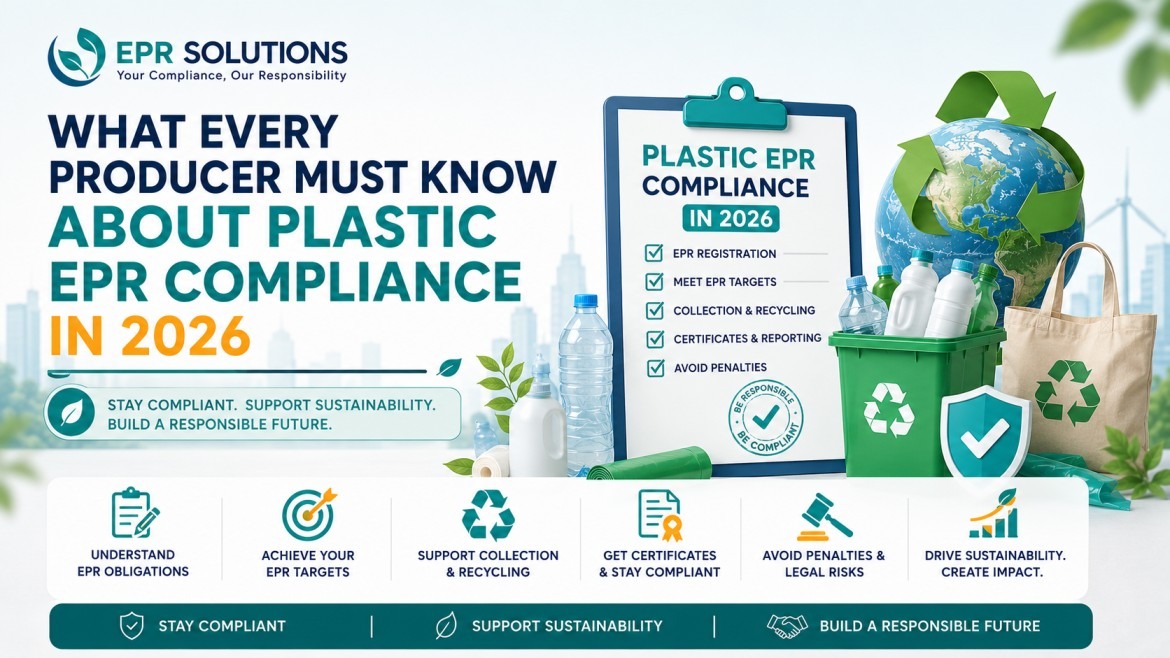
India's plastic waste regulations are no longer just an environmental concern — they have become a critical business compliance requirement. For producers, importers, and brand owners (PIBOs), Extended Producer Responsibility (EPR) is now a legally enforceable framework that directly impacts packaging decisions, supply chains, and regulatory risk.
With multiple amendments to the Plastic Waste Management (PWM) Rules, new CPCB notifications, evolving recycling targets, and stricter reporting requirements, many businesses are struggling to keep up.
This guide breaks down everything producers need to know about Plastic EPR compliance in FY 2025-26, including registration requirements, packaging categories, compliance targets, annual returns, and practical steps to stay compliant.
What is Plastic EPR?
Extended Producer Responsibility (EPR) is a policy mechanism that makes producers responsible for the collection, recycling, processing, and environmentally sound disposal of the plastic packaging they introduce into the market.
Under India's Plastic Waste Management Rules, producers, importers, and brand owners must ensure that an equivalent quantity of plastic packaging waste is collected and processed through authorized recyclers and waste processors. The framework is administered through the Central Pollution Control Board (CPCB) and its centralized EPR portal.
If your business introduces plastic packaging into the market, you are responsible for managing that plastic after consumer use.
Who needs Plastic EPR registration?
Plastic EPR compliance applies to a broad range of business types. Many companies mistakenly assume EPR only affects large FMCG brands — in reality, e-commerce sellers, cosmetic brands, food manufacturers, pharmaceutical companies, electronics brands, and importers may all fall under the framework depending on their packaging footprint.
Producers
Businesses that manufacture plastic packaging materials or plastic packaging products.
Importers
Companies importing plastic packaging, packaged products, raw materials, or plastic-based goods into India.
Brand Owners
Companies selling products under their own brand name using plastic packaging, regardless of whether the packaging is manufactured by a third party.
Plastic Waste Processors (PWPs)
Authorized recyclers, waste-to-energy operators, co-processing units, plastic-to-oil facilities, and composting units.
The four plastic packaging categories
The CPCB classifies plastic packaging into four categories for EPR compliance purposes. Correct classification is essential — misclassifying your packaging leads to incorrect target calculations and potential penalties.
Category I — Rigid Plastic
PET bottles, HDPE containers, plastic jars, caps, lids, and storage containers. Generally higher recyclability.
Category II — Flexible Plastic
Sachets, pouches, plastic wraps, carry bags, and multilayer flexible packaging. Most challenging to collect and recycle.
Category III — Multi-Layered
Packaging with at least one non-plastic layer — plastic-aluminum laminates, food packaging laminates. Requires specialized recycling.
Category IV — Compostable
Certified compostable carry bags, films, and packaging. Must comply with applicable standards before claiming compostability.
Key EPR obligations for producers in FY 2025-26
The EPR framework operates on measurable collection and recycling targets. Businesses are required to:
- Register on the CPCB EPR Portal
- Declare annual quantities of plastic packaging introduced into the market
- Fulfill EPR targets through authorized waste processors
- Purchase and maintain valid EPR certificates where applicable
- Submit annual returns within prescribed timelines
- Maintain supporting documentation and audit records
Failure to meet obligations may result in Environmental Compensation (EC), regulatory action, or restrictions on operations.
EPR recycling targets: what changed?
India's EPR system follows phased compliance targets designed to strengthen the circular economy and increase plastic recovery rates. Government notifications indicate progressively increasing obligations for recycling and recovery over the coming years.
The framework also includes obligations related to recycling, reuse of rigid plastics, and the use of recycled plastic content in packaging. For producers, this means compliance is no longer limited to registration alone — regulators increasingly expect traceability, evidence-based reporting, and demonstrable recovery of plastic packaging introduced into the market.
Latest CPCB updates businesses should know
Stricter registration enforcement
Authorities have directed PIBOs and Plastic Waste Processors operating without registration to obtain approvals through the centralized EPR system. Businesses operating across multiple states must register with CPCB, while those operating in one or two states may register through the relevant SPCB/PCC.
GST invoice linkages
Registered entities are increasingly required to transact with other registered stakeholders, improving traceability across the plastic value chain. Regulatory notices have emphasized the importance of registration numbers and documentation integrity.
Annual return filing extensions
The CPCB has issued multiple extensions related to annual return filings for FY 2025-26, acknowledging operational challenges faced by registered entities. Businesses should continuously monitor official notifications to avoid penalties and missed deadlines.
Step-by-step registration process
Assess applicability
Determine whether your organization qualifies as a Producer, Importer, Brand Owner, or Plastic Waste Processor. Some businesses may fall into multiple categories simultaneously.
Calculate your plastic packaging footprint
Compile data on packaging material type, weight introduced into the market, category classification, and annual sales volumes. Accurate declarations are critical — future EPR targets are based on reported quantities.
Create an account on the CPCB EPR Portal
Register your organization on the centralized plastic EPR portal and create authorized login credentials.
Upload supporting documents
Typical requirements: GST registration, PAN details, CIN (if applicable), IEC certificate (for importers), authorized signatory documents, and business registration certificates.
Submit application & await review
Complete the online application. Applications are reviewed by CPCB or the relevant State Pollution Control Board depending on your operational footprint.
Obtain your EPR registration certificate
Upon approval, you receive an EPR registration number that must be used for all compliance reporting and regulatory filings going forward.
Common compliance mistakes producers make
Inaccurate declarations create future compliance risks and may trigger regulatory scrutiny when discrepancies are identified.
Misclassifying packaging types leads to incorrect target calculations, often resulting in under-compliance.
Late filings attract Environmental Compensation and compliance notices, even when targets have been met.
Businesses must verify that recyclers and waste processors are appropriately registered and authorized under the CPCB portal.
Registration is only the beginning. Ongoing reporting, target fulfillment, and documentation management are equally important.
What producers should prepare for in 2026 and beyond
India's EPR framework is moving toward greater accountability, digital traceability, recycled-content obligations, and measurable environmental outcomes. Recent amendments and regulatory discussions indicate a stronger focus on:
- Mandatory recycled plastic content in packaging
- Improved packaging traceability across the value chain
- Enhanced disclosure and reporting requirements
- Stronger enforcement mechanisms and penalties
- Circular economy integration across industries
Businesses that proactively build internal compliance systems today will be significantly better positioned than those treating EPR as a yearly filing exercise.
Final thoughts
Plastic EPR compliance is no longer a future requirement — it is an operational necessity for every producer, importer, and brand owner dealing with plastic packaging in India. The regulatory landscape continues to evolve, and enforcement is becoming increasingly data-driven.
Organizations that understand their packaging footprint, maintain accurate records, work with authorized recyclers, and stay aligned with CPCB notifications will be in the strongest position to avoid penalties and build sustainable business operations. As India moves toward a circular economy, EPR compliance is rapidly becoming not just a regulatory obligation, but a competitive advantage.
Need help with EPR registration?
Our team guides you through every step — from applicability assessment to certificate issuance.
Talk to an expertFrequently Asked Questions
Yes. Plastic EPR registration is mandatory for Producers, Importers, and Brand Owners (PIBOs) that introduce plastic packaging into the Indian market.
Plastic EPR registration is required for producers, importers, and brand owners introducing plastic packaging into the Indian market.
GST registration, PAN, company incorporation documents, IEC certificate for importers, and packaging details are commonly required.
Non-compliance may result in Environmental Compensation, penalties, and regulatory action.
The timeline varies based on documentation and regulatory review, but most applications are processed within a few weeks.